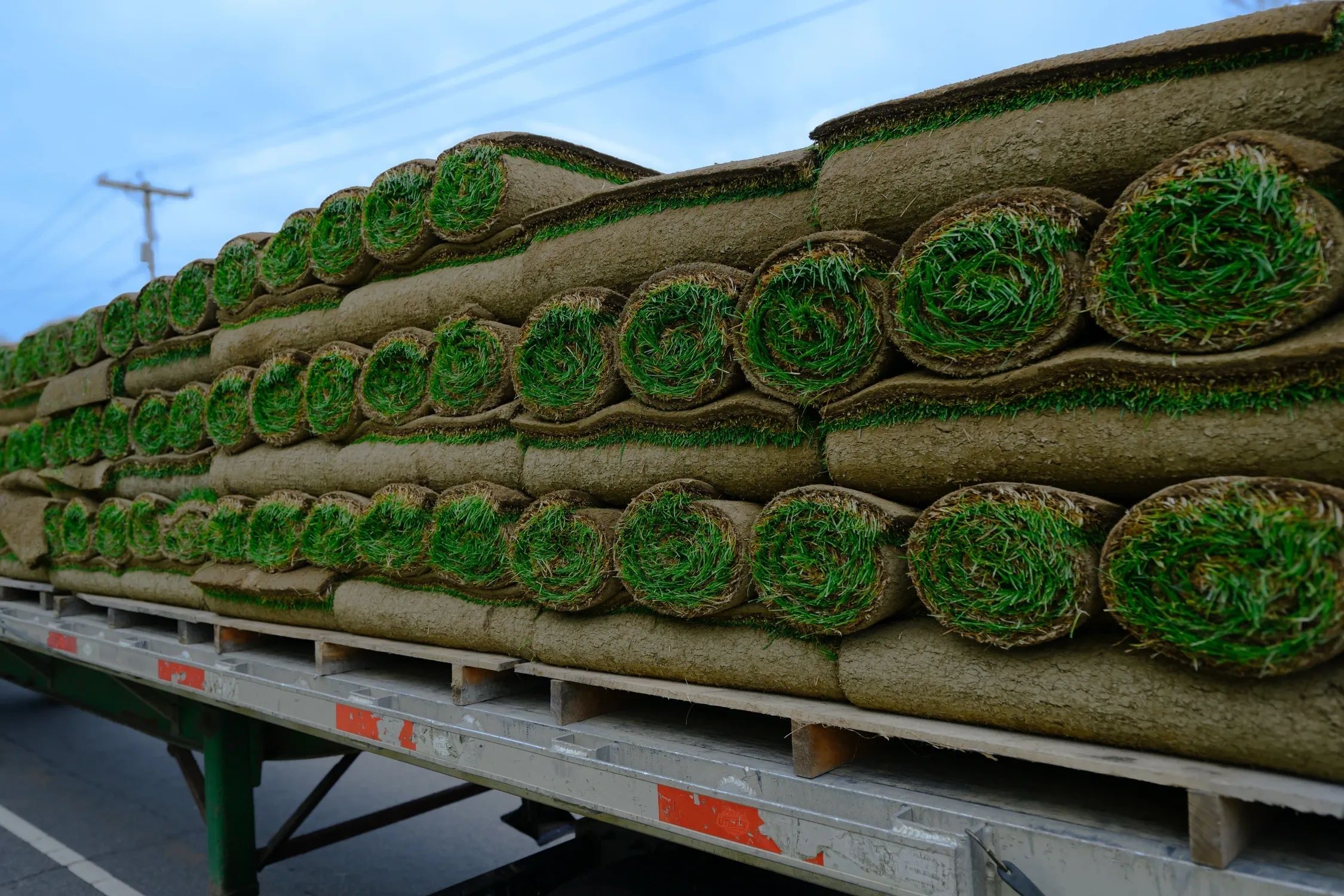
Kentucky Bluegrass Sod
Kentucky Bluegrass Sod: Premium Farm-Cut Delivery and Installation Across the Northeast
Northeast estate properties, contractors, and homeowners choose CT Sod for premium Kentucky Bluegrass — fresh-cut, farm-direct, delivered across 9 states from Greenwich estates to Cape Cod, the Hamptons, the Hudson Valley, the Berkshires, and beyond.
Call (203) 806-4086 to discuss your project, or scroll for the complete guide to Kentucky Bluegrass sod, performance expectations, and what makes farm-cut KBG fundamentally different from anything else available.
Kentucky Bluegrass is the most iconic cool-season lawn in America — and for Northeast properties where appearance, durability, and self-repairing growth matter, it's still the benchmark. This page covers everything you need to know about Kentucky Bluegrass sod: why homeowners choose it, how it performs across the Connecticut, Massachusetts, New York, New Jersey, Rhode Island, New Hampshire, Vermont, Maine, and Pennsylvania climate, what to expect from installation, and how CT Sod delivers premium farm-cut KBG to your property.
Why Kentucky Bluegrass Remains the Standard
Kentucky Bluegrass (Poa pratensis, often called "KBG") has been the American lawn standard for over a century — not by accident, but because of a specific combination of traits no other cool-season grass matches in full. When a homeowner thinks of the ideal Northeast lawn — dense, dark green, fine-bladed, thick enough to walk barefoot through — they're picturing Kentucky Bluegrass.
What sets KBG apart from every other cool-season lawn option:
Self-repair through rhizomes. Unlike tall fescue and perennial ryegrass, which are bunch-type grasses, Kentucky Bluegrass spreads through underground stems called rhizomes. These rhizomes extend 6-12 inches from the parent plant, producing new crowns and shoots that fill in thin spots, damaged areas, and minor bare patches automatically. Over time, a KBG lawn becomes denser and healthier — which is the opposite of what happens to bunch-type lawns, which require overseeding to maintain density.
Color and fine texture. KBG produces the deep, dark green color that defines luxury Northeast lawns. Blade texture is noticeably finer than tall fescue, creating the soft, carpet-like appearance that tall fescue simply cannot replicate.
Cold hardiness. Kentucky Bluegrass handles Northeast winters better than any other premium lawn variety. It emerges from dormancy quickly in spring and often produces its densest growth during the cooler shoulder seasons.
Recovery from damage. Dogs, kids, foot traffic, minor pet damage — KBG recovers through rhizomatous spread in ways that bunch-type grasses cannot. Year-one lawns may look similar to tall fescue; year-five lawns look dramatically different.
Cultivar quality advances. Modern Kentucky Bluegrass cultivars are dramatically different from the KBG varieties your parents or grandparents grew. Named cultivars like Midnight, Award, Shamrock, Moonlight, and Bewitched have been bred for deeper color, improved disease resistance, better heat tolerance, and tighter density. Professional sod farms source these elite cultivars specifically — which is why farm-cut sod outperforms anything you'd establish from generic seed.
For the historical context on how Kentucky Bluegrass became America's lawn of choice — from colonial pastures through Rutgers cultivar breeding to the modern Midnight family that dominates luxury installations — see our complete history of Kentucky Bluegrass, our Merion Kentucky Bluegrass history (the variety that defined the modern American lawn), our Midnight Kentucky Bluegrass cultivar guide, and our comprehensive Kentucky Bluegrass varieties and turf performance guide.
Is Kentucky Bluegrass Right for Your Property?
Kentucky Bluegrass is the right choice for specific conditions. Honest guidance: KBG isn't the best variety for every property. Understanding the fit before you commit saves homeowners from installing the wrong grass and living with it for years.
Kentucky Bluegrass is the right choice when:
- Your property gets at least 6 hours of direct sun daily
- You have or are willing to install an irrigation system (or commit to hand-watering)
- You want the dense, self-repairing lawn that improves over years
- You prioritize appearance and are willing to invest in moderate maintenance
- Your property is residential, with traffic levels that KBG's self-repair can manage
- You're in a climate that experiences real winters — KBG loves the Northeast
Kentucky Bluegrass may not be the right choice when:
- Your property has significant shade (KBG needs sun to perform — see our shaded lawns guide and fine fescue guide for shaded yards)
- You can't reliably water during summer heat
- You want the lowest-maintenance lawn possible regardless of appearance
- Your property faces extreme heat stress (KBG goes dormant above 90°F soil temperatures)
- Your property has heavy dog or active-use traffic that exceeds KBG's repair capacity (consider RTF instead)
If your property has shade challenges, inconsistent watering, or you want maximum drought tolerance, tall fescue or a tall fescue / Kentucky Bluegrass blend may be the better fit. See our complete tall fescue vs. Kentucky Bluegrass comparison for the full decision framework.
For coastal estate properties facing salt exposure, our coastal Northeast variety guide covers the specific considerations that may shift the variety choice toward fescues for shoreline properties.
Not sure which variety fits? Call us at (203) 806-4086 — we'll recommend the right variety for your specific site based on sun exposure, irrigation, soil, and property goals. There's no obligation, and our team installs sod every day across the Northeast — that daily expertise translates directly into honest variety guidance.
What You Get with CT Sod Kentucky Bluegrass
Farm-cut freshness. We don't sit on inventory. Your Kentucky Bluegrass sod is harvested for your specific delivery window, maximizing the window of viability from farm to installation. This matters enormously — sod begins deteriorating within 24-36 hours of being cut, and the difference between 24-hour-fresh KBG and 72-hour-old KBG is visible in the final lawn. For the science behind why freshness drives establishment success, see our 12-month sod rooting timeline.
Elite cultivar sourcing. We partner with sod farms that use modern named KBG cultivars — the Midnight family, Award-type cultivars, and blended elite varieties bred for deeper color, improved density, and better disease resistance. Homeowners sometimes ask about specific cultivars; we'll match the right cultivar selection to your property goals.
All-terrain forklift delivery. Our trucks place pallets exactly where your project needs them — not dumped at the curb. This saves hours of hand-hauling and protects your existing landscape from equipment damage.
Three service tiers. Delivery-only for DIY homeowners and contractors, delivery plus site preparation for homeowners who want help with the heavy prep work, or full-service installation where our experienced crews handle everything from old lawn removal to finished, rolled, watered lawn.
Northeast coverage across 9 states. Connecticut, Massachusetts, New York, New Jersey, Rhode Island, New Hampshire, Vermont, Maine, and Pennsylvania.
Honest guidance. We'll tell you when KBG is the right fit — and when it isn't. We'll tell you when DIY makes more sense than hiring us. The goal is a lawn that performs for years, because satisfied customers become referrals.
Premium Estate and Coastal Markets We Serve
CT Sod regularly delivers and installs Kentucky Bluegrass across the most refined residential markets in the Northeast:
- Westchester / Greenwich / Fairfield County estate corridor — Bedford, Pound Ridge, Chappaqua, Scarsdale, Greenwich, New Canaan, Darien
- The Hamptons and Long Island — East Hampton, Southampton, Bridgehampton, Sag Harbor, Amagansett (also see our dedicated Hamptons estate properties installation guide)
- The Hudson Valley and Catskills — Rhinebeck, Hudson, Millbrook, Garrison, Cold Spring
- Saratoga Springs and the Capital Region — Saratoga Springs, Albany, the Saratoga estate corridor
- The Finger Lakes — Skaneateles, Cazenovia, Canandaigua, the Finger Lakes wine country
- Western New York — Buffalo, Rochester, the Lake Ontario shoreline
- Westport CT coastal estates — Compo Beach, Saugatuck Shores, Greens Farms
- Litchfield County estate corridor — Washington, Roxbury, Kent, Litchfield, Salisbury
- Trumbull, Connecticut and the broader Fairfield County residential market
- Northern New Jersey estate corridor — Saddle River, Alpine, Mendham, Bernardsville, Bedminster
- MetroWest Boston — Wellesley, Weston, Lincoln, Concord (covered in our Boston Suburbs guide)
- Cape Cod and the Islands — Chatham, Osterville, Cotuit, Edgartown, Nantucket
- Newport, Watch Hill, and the Rhode Island coastal estate market
- The Berkshires — Lenox, Stockbridge, Great Barrington
- Lake Winnipesaukee, the Vermont Champlain Valley, Mid-Coast Maine, and the broader Northeast estate market
Kentucky Bluegrass Sod Specifications
- Standard pallet coverage: 500 square feet (50 rolls at 2' x 5' each)
- Optional larger pallets: Up to 600 square feet depending on availability
- Pallet weight: 750 to 2,000 pounds depending on grass density, soil thickness, and moisture content
- Roll size: 2 feet by 5 feet — manageable for DIY installation while minimizing seams
- Cut-to-order: Harvested fresh for your specific delivery window
Minimum Order Requirements by Region:
- Connecticut, Massachusetts, Rhode Island, New York (excluding Long Island), New Hampshire, Vermont, Maine, Pennsylvania: 1 pallet (500-600 square feet)
- New Jersey: 1,200 square feet (2 pallets at 600 sq ft each)
- Long Island and the Hamptons: 1,200 square feet minimum, with a $0.30 per square foot Long Island delivery surcharge
Kentucky Bluegrass Performance in the Northeast
Kentucky Bluegrass is, in many ways, the grass Northeast climates were designed for. Connecticut, Massachusetts, New York's Hudson Valley and Westchester, northern New Jersey, Rhode Island, and the broader cool-season Northeast all fall within KBG's ideal performance zone. Here's what that looks like in practice:
Seasonal Performance
Spring (March-May): KBG emerges from winter dormancy fast and produces dense, fresh growth as soil temperatures reach 50-65°F. This is the prime growth period. Lawns installed the previous fall show their first major density improvement in second spring.
Summer (June-August): Performance depends entirely on water. Well-irrigated KBG maintains color and density through Northeast summers. Poorly-irrigated KBG may go summer-dormant — turning brown and dry-looking — but revives quickly once watering resumes or fall rains arrive. This dormancy isn't death; it's a survival mechanism. (See our guide on whether brown sod can be saved for the full picture.)
Fall (September-October): The second major growth period. Cool nights, warm days, and reduced heat stress create ideal growing conditions. Fall is typically the best time to install new KBG sod because the lawn catches two optimal rooting seasons (fall and following spring) before facing its first real summer stress.
Winter (November-February): Dormant. KBG turns tan but remains alive underground. Winter hardiness is excellent — KBG handles Northeast winter conditions without the dieback that warm-season grasses suffer.
Long-Term Development
KBG lawns follow a characteristic development pattern homeowners should understand:
Year 1: Initial establishment. Visible density is good but not peak — rhizomatous spread is just beginning.
Years 2-3: Rhizome networks expand, canopy thickens, color deepens. Lawns that looked good in year 1 look noticeably better in year 3.
Years 3-5: Peak density development. This is when a KBG lawn becomes the carpet-like, interlocked mat that defines the luxury Northeast lawn aesthetic. Most homeowners report their KBG lawn looks best in year 5 and beyond.
Year 5+: Mature performance. With proper maintenance, KBG lawns can remain at peak quality for decades.
This progressive improvement is one of the key reasons to choose KBG over bunch-type grasses. Tall fescue reaches peak appearance in year 2; KBG continues improving for years. For the complete view of what happens underground during the first 12 months, see our 12-month sod rooting timeline.
Caring for Your New Kentucky Bluegrass Lawn
The First 30 Days
The first month after installation is when decisions matter most. Mistakes made during this period can't be fixed by careful care later.
Watering: 2-4 times daily, short durations, keeping the sod and top inch of soil consistently moist. This is the only time you should water frequently and shallow — the schedule changes fast. See our complete first 14 days new sod aftercare guide.
Traffic: Light walking only. No sustained foot traffic, no pets running on the lawn, no furniture or play equipment. The sod needs uninterrupted time to root before it can handle normal use. (Can I walk on freshly laid sod? covers the full timing.)
Mowing: Wait until grass reaches 3-4 inches and the tug test passes (gently lift a corner of sod — it should resist). First mow is typically 2-3 weeks after installation.
Fertilizer: Wait 30 days. Sod arrives pre-fertilized from the farm, and high-nitrogen fertilizer applied too early creates weak, shallow roots. For the right timing and product selection, see our guide on what fertilizer to use on new sod and the best fertilizer for new sod.
For the first 30 days post-installation, we have a complete day-by-day care guide.
Long-Term Maintenance
Once established, Kentucky Bluegrass care follows a predictable seasonal rhythm:
Watering: 1 to 1.5 inches per week total, delivered as deep, infrequent soakings rather than daily shallow watering. Deep watering forces roots to grow deep; shallow frequent watering creates shallow-rooted lawns that struggle in drought.
Mowing: Maintain at 2.5 to 3 inches. Never remove more than one-third of the blade height in a single mowing. Use a sharp blade — dull blades tear grass and invite disease. Return clippings when possible — they feed the soil microbiome.
Fertilization: Spring and fall are the primary feeding windows. Moderate nitrogen rates support growth without stressing the plant. Excess fertilizer causes rapid flush growth followed by thinning — less is genuinely more with KBG.
Summer strategy: Expect some dormancy in extreme heat if irrigation isn't sufficient. This is normal, not a failure. KBG revives quickly once water returns.
Aeration: Annual core aeration in fall or spring relieves compaction and allows deeper root development.
Overseeding: Unlike tall fescue, Kentucky Bluegrass rarely needs overseeding. The rhizomatous growth fills gaps naturally. This is a major maintenance and cost advantage over bunch-type lawns.
Disease prevention: Modern KBG cultivars resist most common lawn diseases, but ideal conditions still produce occasional issues. Our Kentucky Bluegrass disease prevention guide covers the major diseases and prevention strategies.
Understanding the Soil Underneath
A beautiful Kentucky Bluegrass lawn is not just about the grass — it's about what's happening underground. Homeowners who invest in premium sod varieties and then install them on biologically depleted construction soil are setting themselves up for long-term underperformance, no matter how good the sod is at delivery.
The soil under most new KBG installations has been compromised by decades of construction practices, conventional lawn management, or agricultural legacy. This affects how fast the sod roots, how deep the roots eventually go, how well the lawn survives drought, and how much fertilizer and irrigation the lawn needs over its life.
Understanding this isn't optional — it's the difference between a lawn that thrives for decades and one that requires constant input to maintain. Our research-backed guides cover the full picture:
- Soil Biology and New Sod: Why Most Lawns Are Installed on Dead Soil — the underlying soil condition and what restoration actually requires
- Mycorrhizal Fungi and New Sod Rooting: The Complete Guide — the 450-million-year-old fungal partnership that determines establishment success
- Glomalin: The Soil Protein That Determines Lawn Health — the soil protein responsible for soil structure and water-holding capacity
- Humic Acid and New Sod Establishment — the carbon-rich amendment that supercharges sod rooting
- Biologically Active Starter Fertilizer for New Sod — the complete biology-first establishment framework
- Soil pH and Sod: The Complete Guide — getting the soil chemistry right before installation
- Best Topsoil for Sod in CT — how to evaluate topsoil quality
When we install Kentucky Bluegrass, we factor soil condition into the project plan. When you DIY, the preparation you do before the pallet arrives is the single biggest determinant of long-term success. Our guides on how to prep your yard for sod, how to remove grass before laying sod, and how thick topsoil should be for sod cover the complete preparation framework.
Kentucky Bluegrass Service Areas
We deliver and install Kentucky Bluegrass sod across the entire Northeast:
Connecticut — All of CT, including Fairfield County (Greenwich, Darien, New Canaan, Westport, Fairfield, Milford), New Haven County, Hartford, the shoreline, and northeastern CT. Featured regional pillars: Westchester / Greenwich / Fairfield County, Westport coastal estates, Litchfield County, Trumbull.
Massachusetts — Greater Boston, Boston Suburbs, Cape Cod and the Islands, Worcester, Springfield, the North Shore, the South Shore, and the Berkshires.
New York — Westchester County, Long Island and the Hamptons, Hudson Valley and Catskills, Saratoga and Capital Region, Finger Lakes, Western New York.
New Jersey — Northern NJ estate corridor, Central NJ, Garden State residential markets statewide.
Rhode Island — Providence, Newport, Watch Hill, Block Island, the East Bay corridor, South County coastal communities.
New Hampshire — Lake Winnipesaukee, the Seacoast, the Lakes Region, the White Mountains.
Vermont — Burlington, Stowe, Manchester, the Champlain Valley.
Maine — Mid-Coast Maine, Kennebunkport, Bar Harbor, the Southern Maine coast.
Pennsylvania — Greater Philadelphia, the Main Line, Bucks County, the Brandywine Valley, the Pocono region, Pittsburgh.
If you're in our Northeast service region, we deliver. Call (203) 806-4086 or contact us online to confirm coverage for your specific address.
Pricing and Ordering
Kentucky Bluegrass sod pricing follows our standard volume-tiered structure:
Standard regions (CT, MA, RI, NY excluding Long Island, NH, VT, ME, PA):
- 1 pallet (500 sq ft): $699.00
- 600-1,000 sq ft: $0.90/sq ft
- 1,100-2,000 sq ft: $0.75/sq ft
- 2,100-3,900 sq ft: $0.70/sq ft
- 4,000+ sq ft: $0.66/sq ft
- Fuel surcharge: $50 on all orders 500–900 sq ft
New Jersey (1,200 sq ft minimum, 600 sq ft pallets):
- 1,200-2,000 sq ft: $0.75/sq ft
- 2,100-3,900 sq ft: $0.70/sq ft
- 4,000+ sq ft: $0.66/sq ft
Long Island and the Hamptons (1,200 sq ft minimum, $0.30/sq ft surcharge):
- Long Island delivery surcharge: $0.30/sq ft added to standard volume tier pricing
All Regions:
- Delivery fee: $99.00 per order
- Tall fescue upgrade (when applicable): $0.10/sq ft
Installation services — delivery plus site preparation, or full-service installation — are priced per project based on size, site conditions, and prep requirements.
Get a free quote: Call (203) 806-4086 with your address, approximate square footage, and timing, and we'll come back with honest numbers and our recommendation for your project. There's no obligation, and most quotes are turned around the same day.
Timing and Peak Season Scheduling
Kentucky Bluegrass installations work best in two windows:
Early fall (September-October) — typically the best window for new KBG in the Northeast. Soil temperatures are optimal, heat stress is minimal, and the lawn catches two full rooting seasons (fall and following spring) before facing summer stress. (See our September sod installation and why fall is the best time for sod installation guides.)
Spring (April-June) — the second-best window. Active root growth begins immediately, though the lawn faces first-summer stress with a less-developed root system. (See our spring sod installation guide and is April a good time to lay sod in New England.)
Summer (July-August) — possible but requires intensive watering and careful timing. Early-morning deliveries and same-day installation become critical.
Winter (November-February) — generally avoided in the Northeast. Sod won't root meaningfully in cold soil. (See our guide on how late you can lay sod and how late you can install sod in Connecticut.)
Peak season scheduling: Our delivery and installation calendar fills 1-2 weeks in advance during the spring and fall peak windows. If you're planning a fall installation, book by late August. For spring, book by mid-March. Off-season we can usually accommodate within a week.
Call (203) 806-4086 to lock in your delivery or installation slot before peak season fills.
Frequently Asked Questions
Is Kentucky Bluegrass good for Connecticut, Massachusetts, and New York?
How long does Kentucky Bluegrass sod take to root?
What's the difference between Kentucky Bluegrass and tall fescue sod?
How much sun does Kentucky Bluegrass need?
Does Kentucky Bluegrass go dormant in summer?
When should I install Kentucky Bluegrass sod?
How often should I water my new Kentucky Bluegrass lawn?
Do I need a sprinkler system for Kentucky Bluegrass?
What cultivars of Kentucky Bluegrass do you carry?
Can I install Kentucky Bluegrass over an existing lawn?
How long does a Kentucky Bluegrass lawn last?
Do you offer installation, or just delivery?
What about properties with dogs?
Ready for a Kentucky Bluegrass Lawn?
Get a free quote: Call (203) 806-4086 with your address, approximate square footage, and timing. We'll come back with honest pricing and our recommendation for your specific project — typically same-day during business hours.
Three ways to work with us:
- Delivery-only — Fresh-cut Kentucky Bluegrass delivered to your site for DIY installation or contractor handling
- Delivery plus site preparation — We handle the heavy prep work (old lawn removal, grading, soil amendment) and deliver fresh sod for you or your contractor to install
- Full-service installation — Our experienced crews handle everything from old lawn removal through finished, rolled, watered lawn
What we'll need from you:
- Property address (for delivery routing and any access considerations)
- Approximate square footage (we can help you calculate)
- Timing preferences (peak season fills 1-2 weeks ahead — earlier is better)
- Any site-specific considerations (slope, irrigation, shade, drainage)
Premium Kentucky Bluegrass, farm-fresh, delivered and installed across the Northeast. The lawn standard, done right.
Call (203) 806-4086 today.